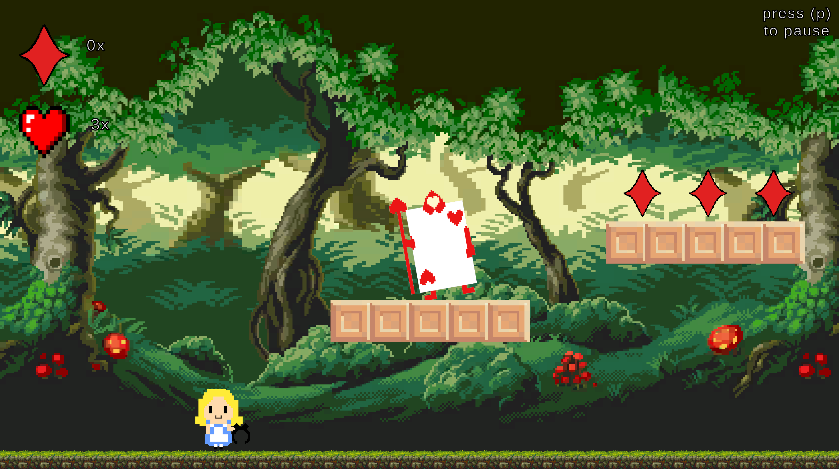
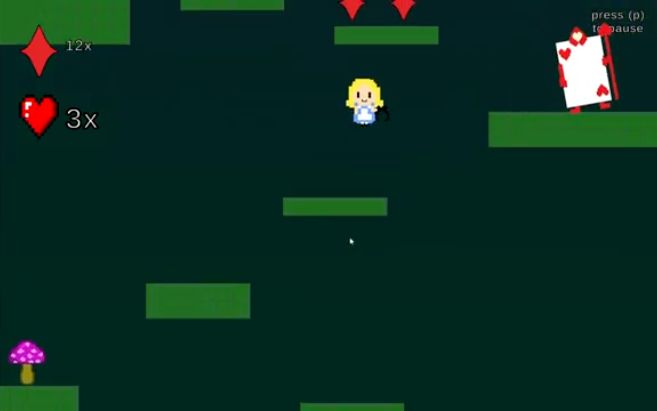
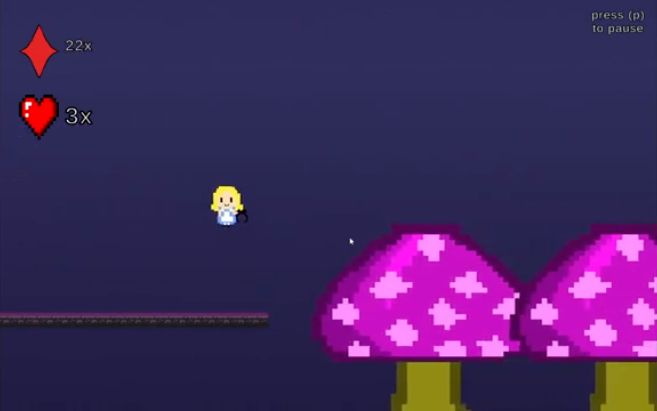
Actual gameplay from the team’s Unity prototype. Art and environments credited below.
AD
Move
Space
Jump
J
Throw headband
My contribution
Gameplay implementation & level ideation
Built with
Unity 2D C#
Team
Jake, Amy Zhang & Delaney University of Pittsburgh
The game
Four stages + a boss Student project
01 / The experience
Familiar moves. Stranger terrain.
Jump, dodge the guards, and throw Alice’s headband. Potion and cake power-ups bring the book’s changing scale into the platformer.
We built on mechanics as the game progressed: small mushrooms introduce a bounce, then larger mushrooms send Alice higher. I implemented the gameplay systems and helped shape the level ideas; Amy built the environments and Delaney created character and item art.
02 / Learn the bounceSmall mushrooms introduce a new way up.03 / Raise the stakesLarger mushrooms build on the same interaction.
Frames from the public gameplay video; gameplay and HUD preserved.
01Forest platforms
02Mushroom ascent
03Bigger bounces
04Moving tiles
FinaleQueen of Hearts
02 / Behind the build
Making the rules work on screen.
My work connected player interaction, character behavior, environment mechanics, and game state. The most useful lessons came from the things that broke.
01 / Placing the guards
Make the setup visible.
Each enemy spawn originally needed its own Transform reference. I replaced that setup with editable X/Y positions within a spawner and added gizmos to show the locations in the scene.
The benefit was easier placement and debugging as we built out levels.
Before
Individual Transform references
↗↗↗
After
One spawner Editable X/Y positions
+++
Visible scene gizmos
Explanatory diagram based on development notes; not a Unity editor capture.
02 / The Queen’s attack
Let the player read what comes next.
The boss’s cards collided with one another, disrupting their spread. I put them on a dedicated layer and disabled collisions between cards so they could follow their intended angles.
I also added a warning line to show where an attack would come from. The encounter became a problem the player could anticipate.
Read the warning
A line signals the incoming attack.
→
React to the cards
↙↓↘
Cards travel without colliding with one another.
Attack logic, summarized from the hurdle tracker. Schematic, not gameplay.
Built, played, adjusted
Delaney tested finished levels and logged bugs while Amy and I built the next. We then retested fixes and adjusted movement speed, jump force, and Alice’s size. Camera constraints also led us to make the mushroom level more horizontal.
03 / What I learned
The next version starts with smaller scripts.
I put too much trigger and tag logic into PlayerController. Next time, I’d move more behavior into the objects Alice interacts with, and start testing movement against the environments earlier.
More frequent Git pushes helped us exchange feedback as we went. But scope still mattered: we cut the Cheshire Cat invisibility idea and dialogue to concentrate on the core game.
The result is a playable prototype—and a much clearer sense of how I want to build the next one.